


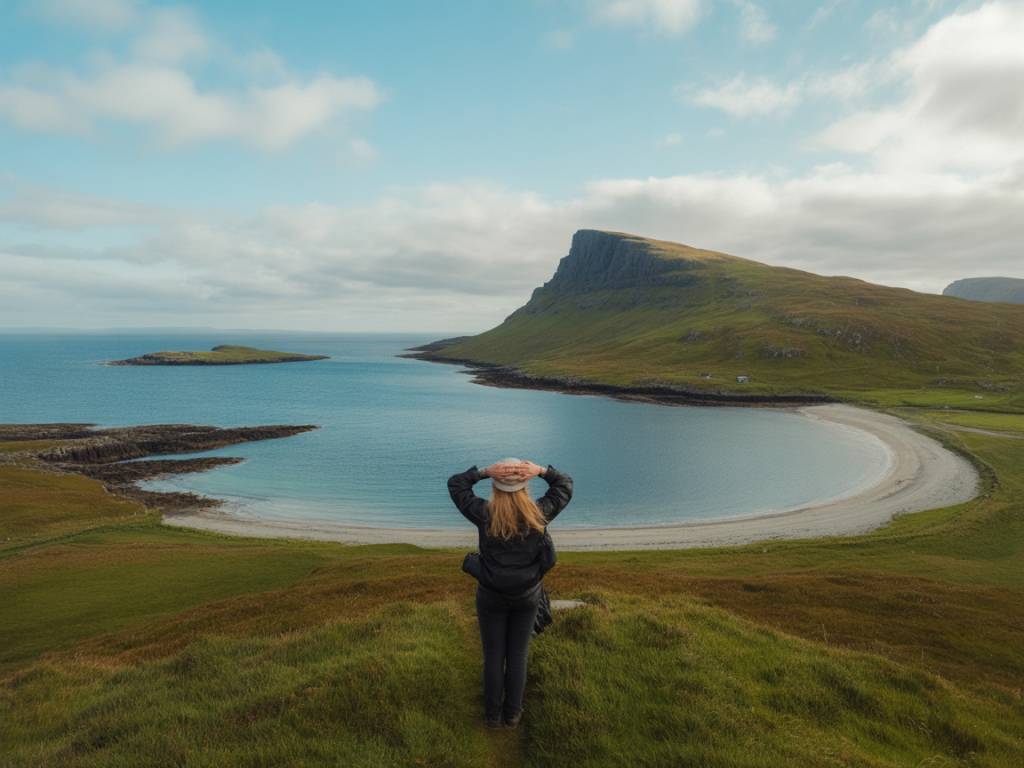
Why the Hebrides are made for slow travel
The Scottish Hebrides are not a place you “do” in three days and tick off a list. Scattered off Scotland’s west coast, these islands – from the famous Isle of Skye to the quieter Outer Hebrides like Harris, Lewis, North Uist and Barra – are shaped by weather, tides and tradition. Everything here encourages you to slow down. Ferries do not rush. Single-track roads demand patience. Cafés open when the owner has finished walking the dog across the machair.
On my first journey through the Hebrides, I realised quickly that trying to squeeze six islands into five days would mean spending more time watching the clock than the Atlantic. Slow travel in the Scottish Isles is about stretching out your itinerary, building in empty space, and letting the islands dictate your rhythm rather than the other way around.
Choosing your Hebridean base: Inner vs Outer Hebrides
When travellers search for “Scottish islands travel” or “Hebrides itinerary”, the choice can feel overwhelming. A slow travel approach starts with accepting that you cannot see it all – and you do not need to.
The Hebrides are loosely divided into:
- Inner Hebrides: Closer to the mainland, including Skye, Mull, Islay and Jura.
- Outer Hebrides: More remote, including Lewis and Harris, North and South Uist, Benbecula, Barra, Eriskay and a scatter of smaller islands.
For a first slow travel experience, two strategies work well:
- Pick one large island and stay put – for example, spend a week on Skye or Mull, exploring different corners without ever repacking your suitcase.
- Choose a short chain of islands – such as Harris and Lewis combined, or Barra and South Uist – and travel slowly between them using local ferries.
Personally, I find the Outer Hebrides lend themselves particularly well to a slow, immersive trip. Distances are longer, public transport is sparser, and there is less nightlife to tempt you into busy evenings. Days naturally stretch, shaped by tides, changing light and the simple question of whether the only café within 20 km happens to be open.
Getting there the slow way: ferries and scenic trains
Reaching the islands is already part of the slow travel experience. Instead of flying directly, consider combining Scotland’s scenic rail lines with ferry routes operated by Caledonian MacBrayne (CalMac).
For the Outer Hebrides, a classic slow route begins in Glasgow. From here, take the train to Oban, a journey of lochs, forests and small stations where deer often outnumber people on the platforms. Oban is both an attractive harbour town and the gateway to many islands. Arriving the evening before your ferry and spending the night here avoids early-morning stress and lets you ease into a gentler rhythm.
For Skye, a favourite route is the West Highland Line to Mallaig, one of Europe’s most scenic railway journeys, with the famous Glenfinnan Viaduct en route. From Mallaig, a short ferry crossing takes you to Armadale on Skye’s Sleat Peninsula. Already, you have travelled for hours without the urgency airports tend to impose.
Ferry timetables are crucial when planning a slow travel Hebrides itinerary. Services can be disrupted by strong winds, especially outside summer. Building in buffer days and avoiding tight connections transforms potential stress into a chance to linger in a harbour café, watching fishing boats and listening to the rise and fall of Gaelic conversations around you.
Living at island pace: accommodation and daily routine
Slow travel is less about what you see and more about how you live while you are there. In the Hebrides, where accommodation is scattered and often family-run, your choice of base shapes your experience.
Self-catering cottages are ideal for those who want to feel part of local life. On Harris, I stayed in a small stone house above Luskentyre Bay, where mornings began not with hotel breakfast buffets but with watching the tides pull back from miles of sand. Shops were a drive away, which meant planning meals in advance and, unintentionally, structuring days around the simple routines of cooking and shopping at the local community co‑op.
On Barra, a room in a guesthouse overlooking the airport’s tidal beach runway turned flight schedules into a kind of natural theatre. Planes only land when the tide is out, so everyone in the house seemed to quietly structure their day around that moment – a short walk to the dunes when the engine hum was heard in the distance.
To appreciate island pace:
- Stay a minimum of three to four nights in each place rather than hopping nightly.
- Accept that not everything will be open every day, especially in smaller communities.
- Embrace self-catering or picnics to avoid hunting for open restaurants late in the evening.
- Let the weather influence your plans rather than fight it; a windy day can be perfect for a long café stop and local conversation.
Connecting with landscape: walking, cycling and coastal wandering
One of the strongest arguments for slow travel in the Hebrides is the landscape itself. These are not islands to be experienced through car windows alone. Distances can be deceptive on the map; what appears as a short drive often hides detours, photo stops, and frequent pauses to let sheep cross the road.
On Lewis and Harris, many visitors aim to “do” the standing stones at Callanish or the famous beaches at Luskentyre and Seilebost. Slowing down means choosing fewer destinations but spending more time at each. At Callanish, I arrived late in the afternoon, after most day-trippers had left. With hours to spare, I walked the surrounding minor stone circles, following sheep tracks through heather rather than rushing back to the car park. The changing light transformed the stones from stark silhouettes to warm, lichen‑covered monoliths.
Cycling is another powerful way to experience the Hebridean landscape, especially on quieter islands like North Uist or South Uist. The wind is a constant companion, sometimes a challenge, sometimes a gift when it pushes you along empty roads lined with lochans and low, white croft houses. Many visitors bring or rent touring bikes and plan short daily distances to allow for unscheduled stops: a tide pool that catches the eye, a ruined blackhouse, or simply a long stretch of machair bursting with summer wildflowers.
For walkers, even short coastal routes can feel expansive:
- On Harris, the walk over the headland at Seilebost opens to vast views towards Taransay and the Sound of Harris, often with only seabirds and shifting clouds for company.
- On Mull, a slow amble to Calgary Bay’s art trail reveals small sculptures tucked into the landscape, invisible to those who simply park, take a photo and leave.
The key is to plan fewer activities per day, allowing time for wanderings and weather changes. On the Hebrides, the sky itself can feel like a destination, worth watching for long stretches from a dune or low stone wall.
Everyday life on the islands: people, language and culture
Many travellers focus on the dramatic coastlines and forget that the Hebrides are also living communities. Slow travel encourages you to engage with that quieter, everyday side of island life.
In the Outer Hebrides, the presence of Scottish Gaelic is noticeable on road signs, in shop announcements, and in casual conversations. Taking the time to learn a few words – “madainn mhath” (good morning), or “tapadh leibh” (thank you) – opens doors. I found that even a hesitant attempt at Gaelic phrases in a café on South Uist led to longer conversations about local schools, crofting rights, and how the language is maintained across generations.
Community hubs are essential for understanding how people really live here:
- Village halls and community centres often host ceilidhs, craft fairs or local markets. Posters on notice boards are the best way to find them.
- Small museums, such as the Blackhouse Village at Gearrannan on Lewis or the museum at Kildonan on South Uist, present history in a grounded, personal way.
- Local churches play a central role in social life, particularly in more observant areas of Lewis where Sundays are still markedly quiet.
Slow travel here also means recognising and respecting local rhythms. Sundays in parts of the Outer Hebrides are quieter: many shops close, and buses may not run. Instead of seeing this as an inconvenience, it can become one of the most memorable days of your trip – a chance to walk, read, or simply sit by the shore without the impulse to move constantly.
Food, drink and the taste of the islands
Food in the Hebrides reflects both remoteness and resourcefulness. You will not find a café on every corner, but what you do find tends to be rooted in local produce: fresh seafood, lamb, and baking that keeps you warm on wind-swept days.
On the Isle of Harris, a slow travel day can revolve around a visit to a small harbour, watching creel boats unload lobsters and crabs. Later, the same catch might appear on a menu as simply grilled shellfish with butter, potatoes and seaweed‑infused salt. On smaller islands, community-run cafés – often part of heritage centres – provide hearty soups, bannocks, and home-made cakes that double as informal social spaces.
The whisky islands of the Inner Hebrides, especially Islay and Jura, lend themselves naturally to unhurried tasting days. Walking between distilleries along quiet roads or shoreline paths reveals the landscapes behind familiar labels. Even for non‑drinkers, distillery tours offer insight into local employment, history and how island economies connect to global markets.
Because shops can be few and far between, planning is part of the experience:
- Stock up on essentials when passing through larger settlements like Stornoway, Tarbert or Tobermory.
- Use small village shops and mobile vans when you can; they are embedded in local life and often double as informal news centres.
- Expect seasonality – some restaurants operate only in summer, and menus change with weather and supply.
Practical tips for a sustainable, slow Hebrides trip
Slow travel and sustainable travel often go hand in hand, especially in fragile island environments. The Hebrides’ ecosystems – from peat bogs to machair grasslands – are resilient but not indestructible.
A few ways to align your trip with local needs:
- Travel off‑peak when possible – May, June and September often bring good weather with fewer crowds than July and August.
- Book ferries and accommodation well in advance, to avoid last‑minute stress and unnecessary to‑and‑fro driving.
- Respect access codes when walking; close gates, avoid disturbing livestock and keep to paths in sensitive dune and machair areas.
- Support small, local businesses – from Harris Tweed weavers to island bakers and artists – rather than relying solely on larger chains.
- Consider staying longer in fewer places, which reduces transport emissions and deepens your sense of place.
Mobile reception can be patchy, particularly in the Outer Hebrides, which nudges you further into offline living. Download maps in advance, carry a paper road atlas, and inform your accommodation if you expect to arrive late. Embracing limited connectivity is, in itself, part of the slow travel ethos.
Letting the Hebrides set the tempo
The temptation, when planning a trip to the Scottish islands, is to fit in as many famous names as possible: Skye, Mull, Islay, Harris, Lewis, Barra. Yet some of my clearest memories from the Hebrides are not of specific “sights” but of unplanned pauses – waiting for a weather front to pass from the shelter of a small bus stop, sharing a bench with an elderly crofter in Tarbert while he described winter storms, or watching the last light fade over a deserted beach simply because there was nowhere else I needed to be.
Slow travel in the Hebrides is less about an itemised agenda and more about giving these islands time to work on you. With a flexible itinerary, a willingness to adjust plans to ferries and weather, and an openness to everyday local life, the Scottish Isles reward patience with a sense of space and clarity that is increasingly rare in European travel.
For travellers tired of rushing between capitals, the Hebrides offer an alternative: days shaped by tides and bus timetables, by café opening hours and the direction of the wind, rather than by checklists. In this remote corner of Scotland, moving slowly is not a travel trend – it is simply the only way the islands make sense.